
Reference
How proficiency is worked out
What the proficiency figure actually means, what counts towards it, and why some skills show no number at all.
Wherever the portal shows how your child is getting on, you'll see a proficiency figure. This page explains, in plain terms, what that number is saying - and, just as importantly, what it isn't.
The short version
Proficiency answers one question: of the skills we've actually been able to measure, how well is your child doing?
It is not a mark out of everything a child could ever learn, and it isn't a test score. It only ever describes the skills your child has had a real chance to try.
Every small skill is judged on its own
Learning is broken into lots of small steps. Each step your child has tried gets its own label:
- Emerging - just starting out
- Developing - getting there
- Proficient - doing well
- Mastered - has it, reliably
Mastered is deliberately hard to earn. Your child has to get a skill right consistently, across several goes - not once by luck. Getting a couple right in a row isn't enough.
The proficiency figure is simply the overall picture those labels paint, put on a scale of 0 to 100.
What counts, and what doesn't
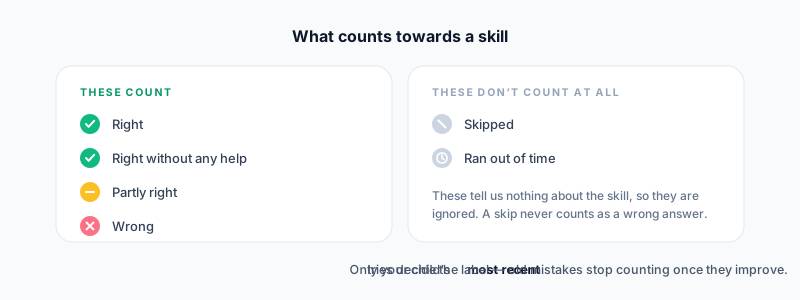
Anything that shows us what your child knows counts - including wrong answers, which are just as much evidence as right ones.
Two things are ignored completely: questions your child skipped, and ones they ran out of time on. Neither says anything about whether they understand the skill, so neither is treated as a wrong answer. A child who skips a lot won't be marked down for it - those questions simply don't enter the picture.
Only your child's recent attempts decide their label. If they found something hard at first and then got the hang of it, those early mistakes stop counting. The number follows where they are now, not where they started.
Why some skills show no number at all
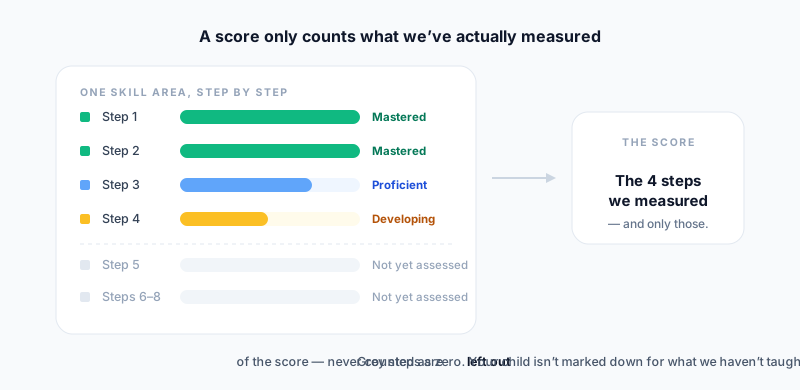
Skills your child hasn't tried show as Not yet assessed, with no number and no bar. They are left out of the score - never counted as a zero.
This matters more than it might sound. If unmeasured skills counted as zero, every child would look like they were failing at things nobody had ever asked them to do. Instead, the score only ever reflects what your child has actually attempted.
You will see a lot of Not yet assessed, and that's expected. The game doesn't yet include activities for every skill in the framework. That's a gap in our content, not a gap in your child.
Reading the figure fairly
A few things worth keeping in mind:
- A handful of goes isn't much to go on. A skill your child has tried twice is a much rougher estimate than one they've practised twenty times.
- A dip isn't a red flag. When a child moves on to harder material, the number often falls before it rises again. That's learning working normally.
- It isn't a comparison. The figure says nothing about how your child compares to other children. It isn't a ranking, a percentile, an assessment or a diagnosis.
If you're looking at a whole area - like Cognitive Development - rather than an individual skill, be aware that figure is worked out slightly differently: it's measured against everything in that area, including the steps the game doesn't cover yet. It will therefore read lower than the skill-by-skill figures, and the two aren't directly comparable.
What to do with it
The most useful thing on the page usually isn't the number - it's the next step. Each skill area shows the next rung your child hasn't mastered yet, which is where practice pays off most.
For how to read the rest of your dashboard, see Understanding your child's progress. For what a particular word means, see the Glossary.